
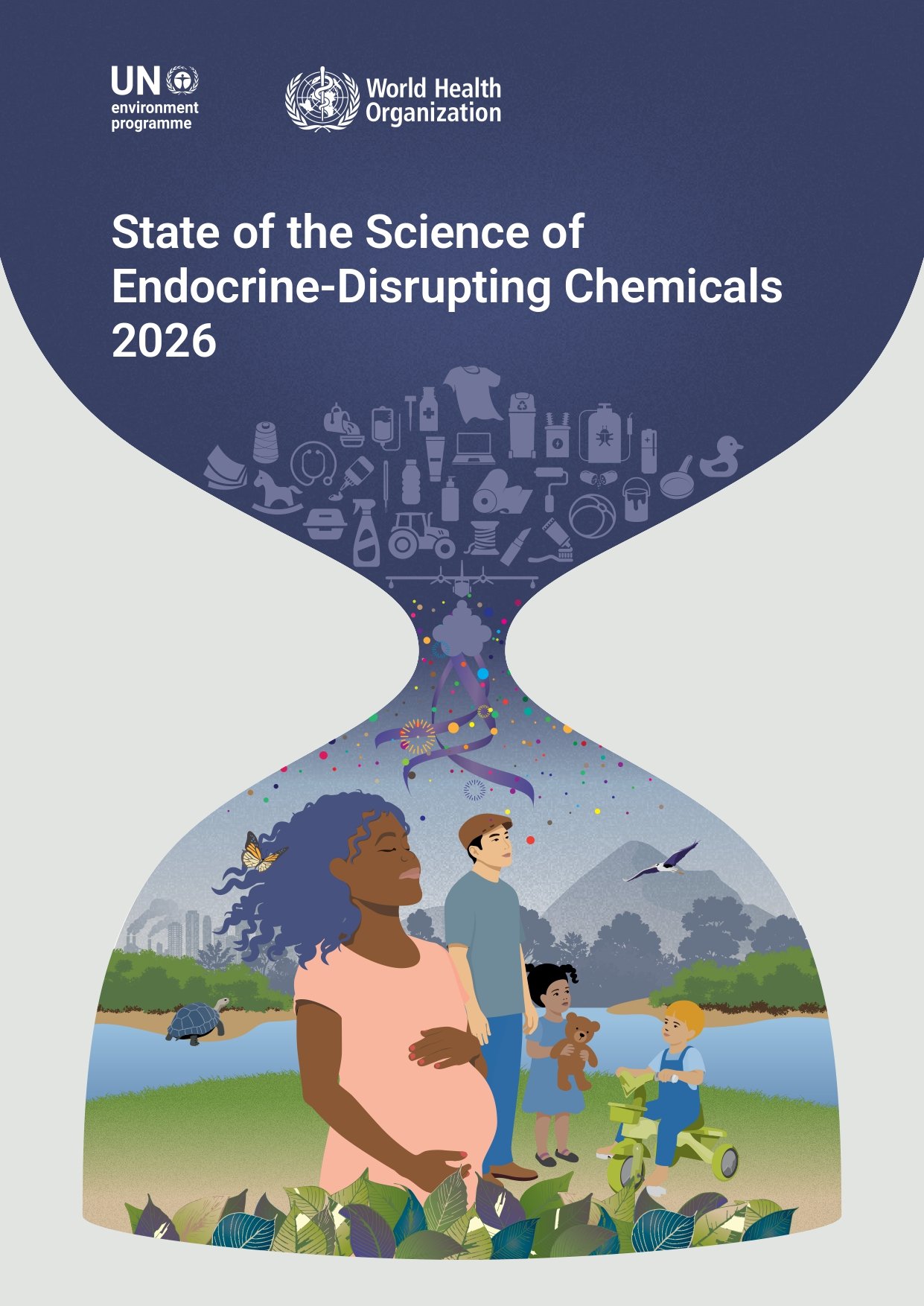
The State of the Science of Endocrine-Disrupting Chemicals 2026 report was launched yesterday by the United Nations Environment Programme (UNEP) and the World Health Organization (WHO) at the First International Conference of the Global Framework on Chemicals (GFC) in Geneva (see press release here). Synthesising over a decade of scientific advances since the 2012 assessment, the report highlights:
1. Stronger scientific evidence linking endocrine-disrupting chemical (EDC) exposure to adverse effects in both humans and wildlife across multiple health and developmental domains.
2. Human and wildlife exposure to EDCs is increasingly documented across ecosystems worldwide, with exposure often beginning before birth.
3. Improved testing programmes identify a growing number of EDCs, the vast majority (>350,000 chemicals) registered for global production and use have not been evaluated for endocrine-disrupting properties.
4. Global health, environmental, and economic costs of EDCs are severe and likely underestimated; global health-related costs alone are estimated >US$ 1.1 trillion annually.
5. Need for stronger governance: Although policy frameworks have evolved since 2012, current regulations remain fragmented and insufficient to transform the products and sectors driving widespread exposure.
Dr Andrea Webster from the Mammal Research Institute was an expert consultant and contributing author on the report, serving as a Global South representative with expertise in non-invasive wildlife contaminant research. Reflecting on the 2024 Geneva discussions with the report's lead authors, global experts from different sectors, disciplines, and governance, members of the UNEP–WHO Expert Group, as well as UNEP and WHO, Dr Webster noted: "It was an opportunity to gain important insights into the shared chemical challenges facing wildlife, ecosystems, human populations." She highlighted the need for coordinated action across industry, regulators, and policymakers and the need to move from "local issue, local solution” problem-solving to "global issue, global solutions" thinking.
Dr webster thanked lead authors, Laura Vandenberg, Tom Zoeller, Juliet Legler, Henrik Holbeck, Martin Scheringer, and Leonardo Trasande and chapter co-authors, Simone Fibiger Sørensen, Alice Baynes, Fela Berecochea, Hana Farnezi, Sander Lentz, Lucia Vergauwen, Dries Knapen, Natalie Aneck-Hahn, Kyungho Choi, and Joëlle Rüegg for their commitment and continued efforts to finalize this report